
Tests & What To Expect
Dr Charlesworth may recommend testing to help diagnose sleep disorders or better understand your symptoms. This page explains the tests commonly ordered through our clinic and what you can expect before, during, and after testing.
If you have questions about your specific test, please contact the sleep lab directly or discuss them during your appointment.
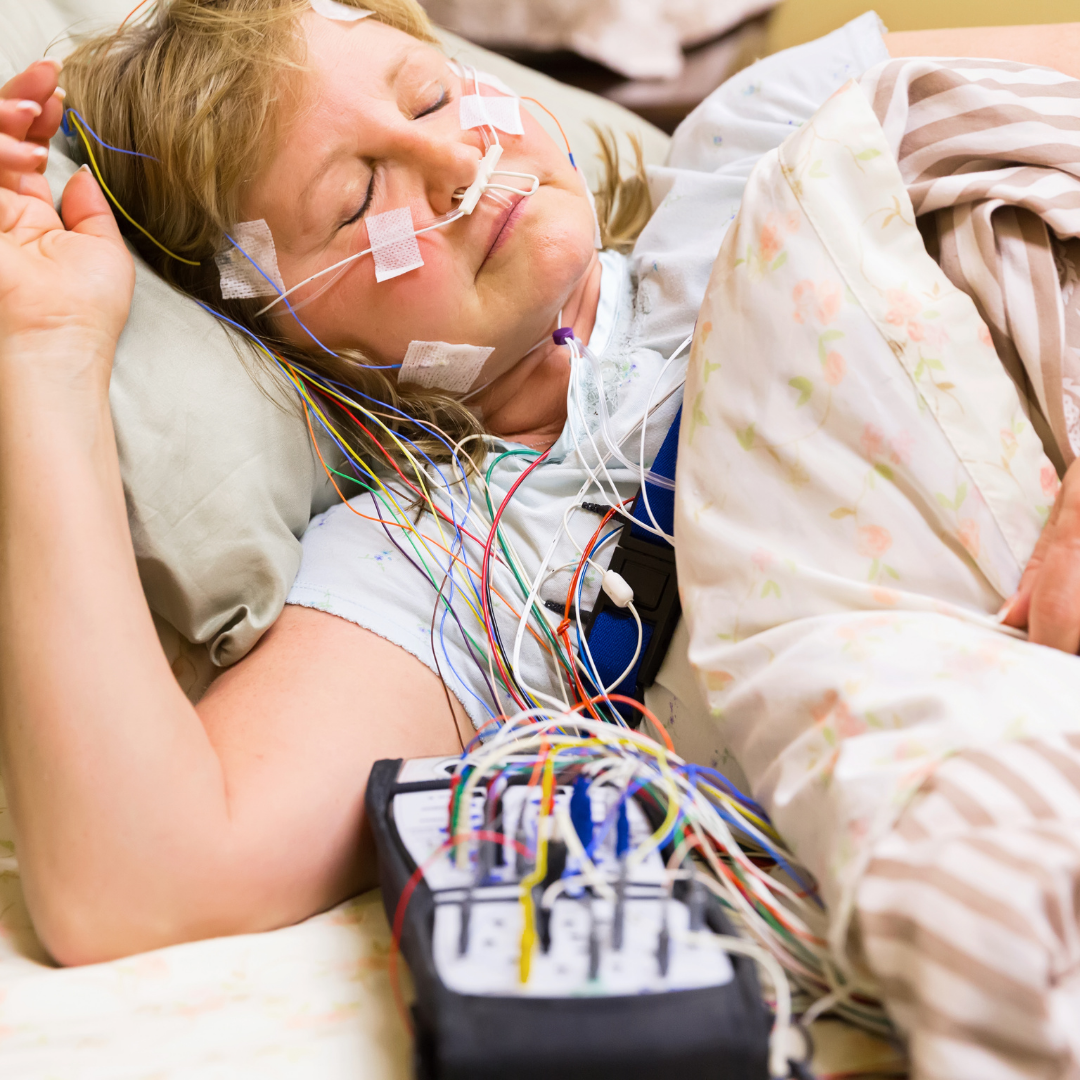
Note: Stock image, not a real patient!
Overnight Sleep Studies
Polysomnography (PSG)
A PSG measures many functions while sleeping such as brain activity (EEG), eye movements, muscle activity, heart rhythm, oxygen levels, and breathing.
There are 3 types of overnight sleep tests done in the sleep lab:
A diagnostic sleep study is used to diagnose conditions such as sleep apnea, parasomnias, and sleep-related movement disorders.
A therapeutic sleep study is performed with CPAP or BiPAP, and allows sleep technologists to adjust pressures to find the optimal treatment for patients. This is sometimes required for patients using BiPAP or CPAP especially if their medical condition is complex.
Sometimes, a diagnostic sleep study transitions to a therapeutic sleep study (CPAP or BiPAP is added part way through the night). We call this a split night study.
-
When you arrive, a sleep technologist will apply a number of sensors and wires to your scalp, face, chest, abdomen, and legs. Many patients are surprised by how many sensors are involved. Although they can feel unusual at first, most people adjust to them over the course of the evening.
After setup is complete, you will have some time before lights out. During this time, you are welcome to follow your usual bedtime routine. For example, you may read, use a tablet or phone, listen to music or podcasts.
While reducing screen use is generally recommended for good sleep hygiene, it is often more helpful during the study to follow your usual evening routine as closely as possible.
The next morning:
Sleep studies end early, usually around 05:30-06:00. Many of the sensors are attached using a conductive paste; after the test, most patients will want to wash their hair / shower and change clothes. If you are planning to go directly to work after the study, please keep this in mind when making arrangements for the morning.
-
On the day of the test, do not nap or drink caffeine after noon.
Do not use moisturizers on your face or body prior to the test. This can impact the recordings.
More information can be found on the Ottawa Hospital’s website here: LINK
-
any medications you usually take in the evening.
hygiene items (toothbrush, comb, etc).
comfortable sleepwear.
if you are particular about your pillow or blanket, feel free to bring your own. Although we have these items available here, some patients prefer to use their own.
-
This is one of the most common concerns patients have. Most people do not feel that they sleep well in the sleep lab; it is a very artificial environment! Some patients even feel they did not sleep at all.
In reality, almost everyone sleeps at least some of the night, and the information collected is usually sufficient for interpretation. The sleep technologist and interpreting physician understand that sleeping in an unfamiliar environment can be challenging.
Even an imperfect night of sleep often provides valuable diagnostic information.

-
This is a nap test in a dark quiet room. It measures how quickly you fall asleep in the day, and what the sleep stages look like during this sleep. This can help to diagnose conditions like narcolepsy and excessive daytime sleepiness.
Patients will be asked to nap 4-5 times during the day.
In between tests, you must stay awake. You are free to read, use screens, work on a laptop, etc between naps. Caffeine is not permitted during the test as this will affect the results.
As standard procedure during the test, we will ask you to provide a urine sample for drug screening. This is performed routinely and non-discriminatorily for every patient undergoing an MSLT. The purpose is to identify substances that may affect sleep or daytime alertness and influence interpretation of the test results.
-
This is a less common test used to quantify a person’s ability to stay awake. It is sometimes used when evaluating effects of treatment for hyersomnolence disorders, or as one part of a safety assessment (for example, safety to drive).
This involves 4-5 sleep opportunities in a dimply lit room, when you are asked to stay awake during this time. You will likely be asked to continue your medications during this test, though please review instructions carefully as this may change depending on the reason for the test.
-
Bring things to do during the day between the tests such as a book, tablet, laptop, knitting, etc.
Review instructions carefully with Dr Charlesworth regarding your medications. Often certain medications are stopped before the test, usually 1-2 weeks before but this changes depending on the situation. Make sure to review instructions carefully, and reach out to Dr Charlesworth’s office if you have any questions.
Substances such as marijuana must be stopped at least a month before the test or this can impact results.
Please keep a sleep diary for 2 weeks before the test. Record your bed time and wake-up time. A template example can be found HERE.
Other Sleep Tests in the Sleep Lab

Other outpatient tests
-
Overnight oximetry is a simple test that measures oxygen levels while you sleep. It is sometimes used to screen for sleep-disordered breathing, assess oxygen levels during sleep, or monitor response to treatment.
This test is performed at home. Sometimes for a single night, and sometimes more nights.
How to arrange:
Overnight oximetry is arranged through a home care company. If you already use CPAP or BiPAP, your vendor can help arrange this for you.
Bring your requisition to the home care company and they will give you the equipment. This is not an OHIP-covered service, so there is usually a small equipment fee, variable depending on the company.
Wear the probe for one or more nights, then return the probe to the home care company.
The results will be sent to Dr Charlesworth directly, and will be reviewed with you at a follow-up appointment.
-
At least a week before your follow-up appointment, make sure your CPAP/BiPAP vendor sends a download to Dr Charlesworth’s office. This can often be done remotely, though for older machines or machines not connected to the network you may need to bring your machine to the vendor in person.
-
MRIs are ordered centrally for the Ottawa area. An MRI may occur at The Ottawa Hospital (Civic or General site), or at Montfort, Queensway Carleton, or outside of Ottawa.
You will be called by the booking office to schedule, who will give you an appointment time and location, and will provide instructions to attend.