Template for documenting a seizure:
Before (pre-ictal): what was happening at time of onset, any trigger, any aura?
During (ictal)
Duration (timed vs estimated)
Onset (versive head turn, ictal cry, posturing, etc)
Eyes (open/closed, deviated)
Movements (stiffening / rhythmic; synchronous; distribution (unilateral/bilateral, arms/legs, pelvis/head)
Other: tongue biting, incontinence
Treatment
After (post-ictal): time to baseline, focal deficits.
Choosing to start an anti seizure medication
Typically only start if >60% risk of additional seizure.
≥2 unprovoked seizures. (ie. Substance-induced do not qualify).
Seizure + imaging abnormality or EEG abnormality.
High-risk features to consider:
FHx epilepsy
PMHx major head injury
Nocturnal seizure
Status epilepticus on first presentation*
*NOTE: this does not clearly indicate higher risk of recurrence!
In remote (± rural) settings, consider a lower threshold to start ASM:
Status epilepticus in a remote setting often a life-threatening situation.
Shared decision-making with patient.
Balance risk of seizure in a low-resource setting vs risks of adverse effects from ASM.
How to choose:
www.epipick.org - very helpful guideline especially for patients with comorbidities or specific demographic factors.
Consider patient factors:
Epilepsy type: focal vs generalized (NEW adult-onset seizures most often focal).
Possibility of pregnancy:
Best: LTG, LEV
Avoid VPA, TPX. Caution with enzyme inducers interaction with hormonal OCP.
Obesity: avoid VPA (weight gain)
Consider patient comorbidities:
Requires DOAC (ex. post-stroke):
Best: LEV, LAC, BRV
Avoid: inducers CBZ, PHT, PB.
Mood / psychiatric history:
Best: LTG, LAC, CBZ
Avoid: LEV, PER
Cardiac conduction abn: caution with any Na+ channel blockers, especially LAC.
Med specific:
Consider access: older medications may be more accessible. In resource-limited settings, supply issues may contribute to medication interruptions. Discuss with pharmacy prn.
Once-daily dosing: cenobamate, ESL, PHT.
Coverage: most ASMs can be accessed through EAP or NIHB special access.
Levels available: PHT, CBZ, VPA ± LEV (usually send-out / delayed).
Legend:
VPA - valproic acid
PHT - phenytoin
LEV - levetiracetam
LAC - lacosamide
TPX - topiramate
PB - phenobarbital
PER - perampanel
ESL - eslicarbazepine
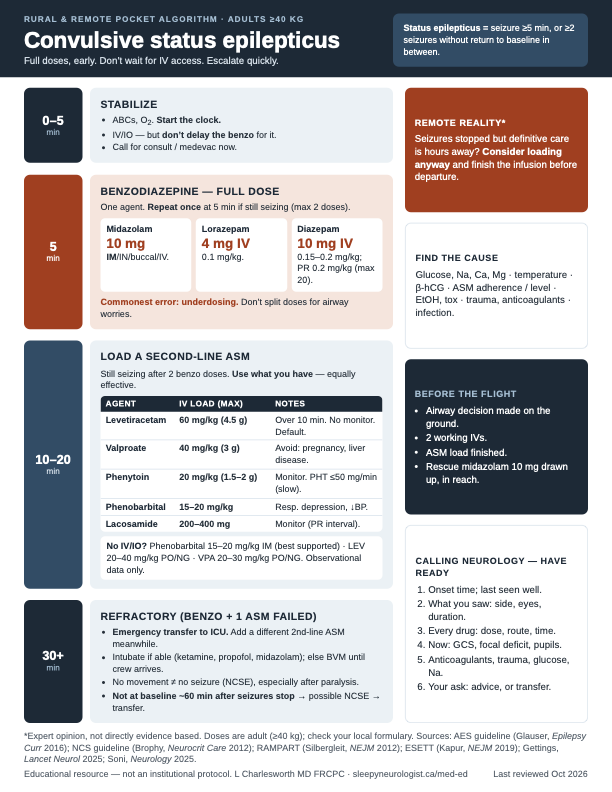
Transfer or observe? Seizure checklist and call script
After a seizure stops, the decision that matters most is whether this person needs medical transport, and the acuity (medevac vs “schedevac”).
This is for adults who have had a seizure or status epilepticus and are now in your care at a nursing station, health centre, or small hospital. This assumes you have no CT, no EEG, and a medevac measured in hours.
Transfer if any of the following:
Seizures are refractory, or recur despite an appropriately dosed benzodiazepine and antiseizure medication.
The patient is not improving within ~60 minutes of the seizure stopping. Non-convulsive status can’t be excluded without EEG.
There is a new or worsening focal deficit that is not clearly resolving.
The patient takes an anticoagulant, or there is a recent history of head trauma.
There is fever, meningism, or immunosuppression.
The patient is pregnant or up to 6 weeks postpartum.
The airway is a concern, or the patient needed a large sedative dose (benzodiazepine or phenobarbital).
You can’t observe them safely: there’s no overnight staff, no one can stay with them, or you’re worried.
Consider local observation when all of the following apply:
The patient is back to baseline or clearly improving on serial exams.
There is a known cause (known epilepsy diagnosis, clear provoking factor such as substance use).
Glucose, Na, and other POCT results are normal or corrected.
Someone can observe the patient and call for help, and there is a plan if another seizure occurs.
A new seizure always needs head imaging. CT can wait (ex. standard transport as opposed to medieval) when all the following apply:
The patient is back to baseline with a normal neurological examination.
No head trauma or anticoagulation.
No fever, red-flag headache features (SNOOPPP), no history of immunosuppression.
Outpatient imaging and follow-up are booked.
Communicating with Neurology on call:
Have these in front of you. You don’t need a full neurological exam; the neurologist will walk you through what matters.
Times: when the patient was last seen well, when the seizure started, and when each seizure stopped.
What was seen: which side started, any eye or head turning, whether the eyes were open or closed, and how long it lasted. Ask whether anyone has phone video.
Every drug given: name, dose, route and time, including anything EMS or family gave.
Usual medications: antiseizure drugs with doses and adherence, and any anticoagulant.
Now: GCS, pupils, which limbs move, speech, and vital signs.
Results: glucose, sodium and any other point-of-care tests.
Logistics: realistic medevac arrival time, and what your site can and can’t do (intubation, infusions, overnight staff).
Your question: advice only, or transfer.
S — Situation: who you are, where you are, and your question.
B — Background: seizure history, usual antiseizure medications and adherence, anticoagulants, and other key history.
A — Assessment: timeline, what you saw, every drug with dose and time, current exam, and results.
R — Request: what you need, and your constraints.
Always with a readback.
Going-home plan for patients with seizures
